Showing posts with label vulnerability. Show all posts

Sunday, January 13, 2013

FIX for Oracle Java 7 Security Manager Bypass Vulnerability

Oracle launch  new version of Java for Oracle Java 7 Security Manager Bypass Vulnerability

Systems Affected

Any system using Oracle Java 7 (1.7, 1.7.0) including
  • Java Platform Standard Edition 7 (Java SE 7)
  • Java SE Development Kit (JDK 7)
  • Java SE Runtime Environment (JRE 7)
All versions of Java 7 through update 10 are affected.  Web browsers using the Java 7 plug-in are at high risk.

Overview

A vulnerability in the way Java 7 restricts the permissions of Java applets could allow an attacker to execute arbitrary commands on a vulnerable system.

Description

A vulnerability in the Java Security Manager allows a Java applet to grant itself permission to execute arbitrary code. An attacker could use social engineering techniques to entice a user to visit a link to a website hosting a malicious Java applet. An attacker could also compromise a legitimate web site and upload a malicious Java applet (a "drive-by download" attack).
Any web browser using the Java 7 plug-in is affected. The Java Deployment Toolkit plug-in and Java Web Start can also be used as attack vectors.
Reports indicate this vulnerability is being actively exploited, and exploit code is publicly available.
Further technical details are available in Vulnerability Note VU#625617.

Impact

By convincing a user to load a malicious Java applet or Java Network Launching Protocol (JNLP) file, an attacker could execute arbitrary code on a vulnerable system with the privileges of the Java plug-in process.

Solution

Install new version Java Runtime Environment 7 Update 11.


Source :  http://www.us-cert.gov/cas/techalerts/TA13-010A.html

Saturday, September 1, 2012

Just one day after the correction of security breach, there is another even worse ...

From Dan Goodin  [http://arstechnica.com]

Researchers said they've uncovered a flaw in the Java 7 update released by Oracle on Thursday that allows attackers to take complete control of end-user computers.

The flaw in Java 7 Update 7, which Oracle released to stop in-the-wild attacks that silently install malware on end-user machines, is the latest black eye for the security of the widely used software framework. It comes after revelations that Oracle learned of the vulnerabilities under attack in April, four months before the exploits were detected. Oracle has yet to explain the delay in fixing the bugs.

The latest bug "facilitates full Java sandbox bypass on latest Java 7 Update 7," Adam Gowdiak, the CEO of Poland-based Security Explorations, wrote in an e-mail to Ars. His team developed proof-of-concept code and delivered it on Friday to Oracle engineers. The discovery of the new critical bug was reported earlier by IDG News. There are no reports that it is being exploited online.

Java "applets" run in a secure sandbox that prevents them from interacting with sensitive operating-system functions unless authorized.


"The total hunt took about 2-3 hours," Gowdiak wrote. "It was done yesterday in the evening. The discovery was made [as] a result of a manual analysis of Java code (its implementation)."


Gowdiak declined to discuss technical details out of concern that they may make it easier for criminals to exploit the flaw in e-mail- or Web-based attacks. He said the discovery came "while trying to fix the proof-of-concept codes that stopped working after applying the recent Java patch."


An Oracle spokeswoman responding to a request for comment referred Ars to this advisory, which was published with Thursday's update. She and other representatives didn't respond to a follow-up e-mail informing her that the advisory was published before the most recent vulnerability was discovered.


This week's attack, and Oracle's lack of public response to them, has renewed calls by many—this reporter included—to remove Java from computers that don't use the cross-platform framework. Many programs that claim Java is required work fine, or almost as well, without the Oracle software, as confirmed by at least two Ars readers on Thursday. Even when it's mandatory for programs such as Adobe Photoshop, as one Mac-using Ars reader reported, users may want to remove Java plugins from their browsers if the websites they regularly visit don't require it. The removal advice has proved controversial to some, so Ars readers are encouraged to decide for themselves. (Oracle's official Twitter account for Java has also disagreed with the advice.)

Two of some 19 bugs that Gowdiak's firm reported in April were among those combined in the latest proof-of-concept attack to completely bypass the security sandbox Java relies on to ensure untrusted code can't access sensitive operating-system functions. Some of the remaining holes still haven't been plugged, and when linked to the latest discovered flaw, attackers could once again have the ability to escape the safety perimeter.

Said Gowdiak: "When combined with some of the April 2012 issues, the new issue allows [one] to achieve a complete [Java virtual machine] sandbox bypass in the environment of latest Java SE 7 Update 7 (version that was released on August 30, 2012)."

Source: http://arstechnica.com/security/2012/08/critical-bug-discovered-in-newest-java/

Friday, August 31, 2012

Security flaw resolved in versions of Java 7u7 and 6u35

Security Alert for CVE-2012-4681 Released

Oracle has just released Security Alert CVE-2012-4681 to address 3 distinct but related vulnerabilities and one security-in-depth issue affecting Java running in desktop browsers. These vulnerabilities are: CVE-2012-4681, CVE-2012-1682, CVE-2012-3136, and CVE-2012-0547. These vulnerabilities are not applicable to standalone Java desktop applications or Java running on servers, i.e. these vulnerabilities do not affect any Oracle server based software.


Apparently, Oracle knew about the problem for months, and did nothing to resolve it. Who says researchers are security Security Explorations, have warned that indicate the company several months ago.

 The Venturebeat says that the security company has released a list of all the vulnerabilities of the code and sent to Oracle in April. In response, Oracle said it had received the report and that the update should be released in June. However, continue to investigate other problems until August.


To check the version you have installed should re-enable Java in the browser, if the disabled are as indicated, and access Java test page.

Due to the high severity of these vulnerabilities, Oracle recommends that customers apply this Security Alert as soon as possible. Furthermore, note that the technical details of these vulnerabilities are widely available on the Internet and Oracle has received external reports that these vulnerabilities are being actively exploited in the wild.

For more information:
 
I recommend you uninstall all previous versions of Java (JRE and JDK), and install the new versions.

Source: https://blogs.oracle.com/security/entry/security_alert_for_cve_20121

Wednesday, August 29, 2012

Java 7 (1.7) JRE vulnerability

Are you vulnerable to the latest Java 0-day exploit?

Test to see if you're vulnerable.

The DeepEnd Research have been in contact with Michael Schierl  the Java expert who discovered a number of Java vulnerabilities, including recent the Java Rhino CVE-2011-3544 / ZDI-11-305 and  CVE-2012-1723. We asked him to have a look at this last exploit . Michael sent his detailed analysis, which we will publish in the nearest future and a patch , which we offer on a per request basis today.

The Fix

There is no fix yet. The solution is disable Java plugin in all your browser to prevent malicious applets from running. The latest iteration of Java is version 1.7 revision 6. This is now the default version on Windows. Mac OS X still uses Java 1.6 (latest version: 1.6.33). Java 1.6.33 is NOT vulnerable to the latest 0-day exploit. However, I would not suggest that anybody downgrade from Java 1.7 to Java 1.6 as it is not yet known if version 1.6 is vulnerable to other flaws fixed in 1.7.


 Firefox

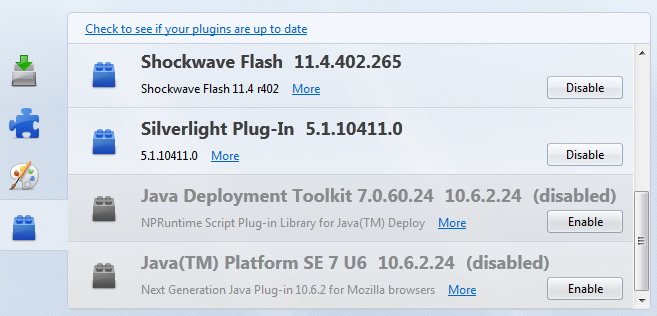
Go to Tools - Add-ons - Plugins

Look for Java Deployment Toolkit and/or Java Platform SE. Disable them all.


Java disabled in Firefox

Chrome

Go to WrenchSettings and Show advanced settings... - Privacy and Content settings - Plug-ins - Disable individual plug-ins... - Java - disable. It is quite difficult to find!

Java enabled in Chrome

Internet Explorer

Go to Tools - Manage Add-ons. Disable Java(tm) Plug-in SSV Helper and Java(tm) Plug-in 2 SSV Helper.


Java disabled in Internet Explorer 9
Sources : 
  • http://research.zscaler.com/2012/08/are-you-vulnerable-to-latest-java-0-day.html
  • http://www.deependresearch.org/2012/08/java-7-0-day-vulnerability-information.html